
The silence of a hybrid car gliding through a parking lot is a symphony to its owner – until that dreaded moment the “Check Hybrid System” warning illuminates the dashboard, often accompanied by the “Triangle of Doom.” For owners of aging hybrid vehicles, particularly those with 150,000 miles or more, this often signals the inevitable: a failing high-voltage battery. Faced with a potentially crippling repair bill, a critical question arises: is hybrid battery reconditioning a smart, economical, and environmentally friendly choice, or is biting the bullet and buying a brand-new battery the only path to long-term peace of mind?
What is Reconditioning, Really?
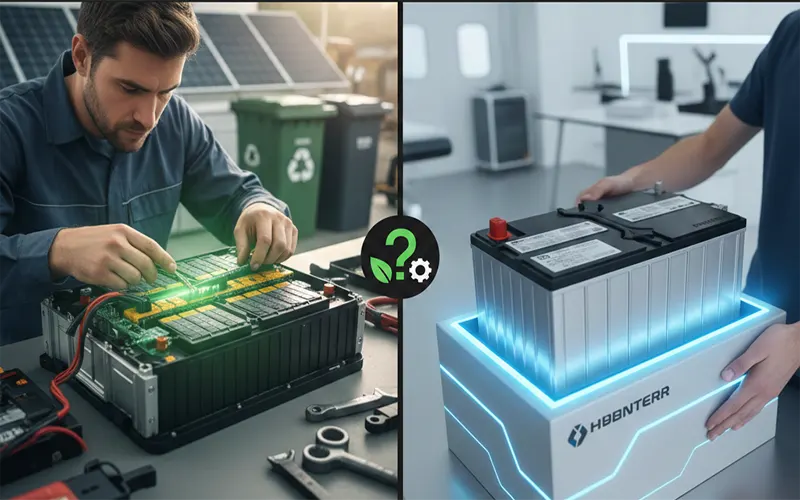
Battery reconditioning is often misunderstood, conflated with simpler, less effective “repairs.” True reconditioning is a sophisticated, multi-step process performed by specialized shops, not a DIY project. It involves removing the entire battery pack from the vehicle, disassembling it into individual modules (cells), and then rigorously testing each one. Modules found to be weak or faulty are either replaced with known good, balanced modules or are subjected to a “deep cycle” process. This deep cycling involves fully discharging and then carefully recharging each module multiple times to break down internal resistance and restore lost capacity. The goal is to bring all modules to a similar State of Charge (SOC) and voltage, creating a more balanced and efficient pack. This contrasts sharply with a simple “cell repair,” which might just involve swapping out the one or two obviously dead cells, leaving the remaining aged and unbalanced cells prone to rapid failure. A properly reconditioned pack will be balanced, tested, and come with a warranty, albeit often a shorter one than a new battery.
The Case for Reconditioning
The allure of reconditioning is primarily financial and environmental. At roughly $1,200 to $1,800, a professional reconditioning service can be significantly cheaper than the $3,000 to $6,000 price tag for a brand-new Original Equipment Manufacturer (OEM) battery. For a hybrid vehicle with high mileage (e.g., 180,000+ miles) where the car’s overall remaining lifespan and market value might not justify a $5,000 investment, reconditioning offers a cost-effective reprieve. It extends the vehicle’s utility for several more years, deferring the expense of a new car.
From an environmental standpoint, reconditioning aligns perfectly with the principles of a “circular economy.” By restoring existing battery packs, it significantly reduces the demand for new raw materials and minimizes the amount of electronic waste (e-waste) heading to landfills. Given that hybrid batteries contain various metals and chemicals, recycling them is energy-intensive. Extending their life through reconditioning is a greener option. For owners planning to keep their car for another 2-3 years, reconditioning provides a practical and sustainable bridge solution.
The Case for Buying New
While reconditioning offers immediate savings, a brand-new battery provides unparalleled peace of mind and long-term predictability. The most compelling argument for a new OEM battery is the warranty, typically an impressive 8 to 10 years or 100,000 to 150,000 miles. This starkly contrasts with the often-limited 12-to-24-month warranty on reconditioned packs. This extended coverage means that any unexpected battery degradation within that period is covered, eliminating future repair anxieties.
New batteries offer superior performance, better fuel economy (as they operate at peak efficiency), and consistent reliability. One of the inherent challenges with reconditioned batteries is the “cell health variance” within an aging pack. Even after balancing, some modules may still have higher internal resistance or lower latent capacity, making them susceptible to faster degradation than truly new cells. This means that while a reconditioned battery can last 3-5 years, it’s not uncommon for them to fail again in 18-36 months, negating some of the initial cost savings. Furthermore, for those considering selling their hybrid, a receipt for a “Brand New Hybrid Battery” can significantly boost resale value, reassuring potential buyers about the car’s longevity and reliability, often justifying the higher upfront cost.
The 2026 Context: NiMH vs. Li-ion
The landscape of hybrid batteries is evolving. Older hybrids, such as early Toyota Priuses, Honda Civics, and Ford Escapes, predominantly use Nickel-Metal Hydride (NiMH) batteries. These packs are generally more amenable to reconditioning due to their chemical composition, which tolerates deep cycling well. However, most modern hybrids, including many from the mid-2010s onwards, utilize more advanced, lighter, and more energy-dense Lithium-ion (Li-ion) batteries. Li-ion batteries behave differently; they are typically sealed units, often have more sophisticated Thermal Management systems, and are generally less suitable for reconditioning at the module level by independent shops. While Li-ion packs degrade over time like NiMH, their construction often means that when they fail, full replacement is the more viable and sometimes only option.
The Verdict: When to Do Which
The decision hinges on a few critical factors:
- Age and Mileage of the Car:
- Under 10 years old / Below 100,000 miles: A new OEM battery is almost always the financially sound choice, ensuring long-term reliability and maximizing resale value.
- Over 12 years old / Above 150,000 miles: Reconditioning becomes highly attractive. The car’s overall lifespan and diminishing market value make a full new battery potentially an overinvestment.
- Planned Ownership Period:
- Selling within 1-3 years: Reconditioning is a sensible, lower-cost option to keep the car running reliably until sale.
- Keeping for 5+ years: A new battery offers the best long-term value, peace of mind, and robust warranty coverage.
- Budget & Risk Tolerance:
- Strict Budget / Emergency Fix: Reconditioning offers an immediate, affordable solution. Be prepared for a potentially shorter lifespan than a new battery.
- Desire for Predictability & Long-Term Investment: A new battery eliminates immediate future worries, though at a higher initial cost.
Ultimately, reconditioning is a viable and environmentally responsible solution for extending the life of an aging hybrid, particularly those with NiMH batteries. However, it’s crucial to understand its limitations regarding lifespan and warranty. A new battery, while a significant investment, provides unparalleled longevity, reliability, and peace of mind, especially for newer vehicles or those intended for long-term ownership. Evaluate your specific vehicle, your financial situation, and your ownership goals carefully to make the most informed decision.