
For the last decade, the electric vehicle revolution has been largely defined by a single barrier to entry: the price tag. While early adopters and luxury buyers have enjoyed the instant torque and silent cabins of Teslas, Rivians, and high-end Fords, the average family has been left on the sidelines. For years, the industry average for a new EV hovered stubbornly above $50,000, leaving many to wonder if the electric future was reserved only for the wealthy.
But the tide is finally turning. As we approach 2026, a convergence of improved manufacturing techniques, falling battery material costs, and aggressive competition is creating a new market segment that has been missing for years: the truly affordable electric SUV. We aren’t talking about tiny city cars or glorified golf carts; we are talking about capable, family-ready crossovers with respectable range.
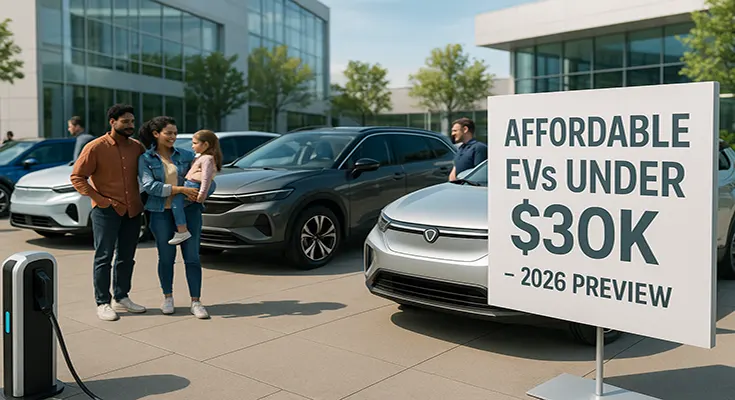
For the budget-conscious buyer, the wait is almost over. 2026 is shaping up to be the “Year of the Affordable EV.” If you have been holding on to your gas-powered sedan, waiting for the moment when going electric makes financial sense, this is the roadmap you have been waiting for. Here is a deep dive into the most anticipated affordable electric SUVs under $30k arriving by 2026.
The “$30k Challenge”: Why Now?
Before looking at the specific cars, it is important to understand why 2026 is the magic year. Why couldn’t automakers do this three years ago?
The primary driver is the shift in battery technology. For years, Nickel-Manganese-Cobalt (NMC) batteries were the standard. They are energy-dense but expensive to produce due to the high cost of cobalt and nickel. However, 2025 and 2026 will see a massive influx of vehicles utilizing Lithium Iron Phosphate (LFP) batteries. LFP batteries are significantly cheaper to produce, safer, and have a longer lifespan, even if they offer slightly less range per pound.
Additionally, legacy automakers like GM and Kia have finally scaled their dedicated EV platforms (like Ultium and E-GMP), allowing them to spread development costs across millions of vehicles rather than thousands. This economy of scale is the secret sauce that brings the sticker price down.
The Top Contenders: What to Watch For
While release schedules are always subject to change, the following models represent the strongest candidates for the sub-$30,000 crown in 2026.
1. The Return of the King: Next-Gen Chevrolet Bolt EUV
When Chevy canceled the Bolt in 2023, there was an outcry from budget-conscious drivers. It was, effectively, the only affordable option on the road. GM listened. The next-generation Chevy Bolt is confirmed to return, built on the superior Ultium platform.
While the original Bolt was a bit quirky, the 2026 iteration is expected to mature significantly. By utilizing LFP batteries and faster charging architecture (solving the original Bolt’s biggest weakness: slow DC fast charging), this vehicle is poised to dominate the entry-level segment. GM has strongly hinted that this vehicle will undercut the Equinox EV, placing it firmly in the $25,000–$28,000 range before incentives.
- Why it’s anticipated: It combines a trusted nameplate with modern charging speeds and better battery tech.
- The target buyer: The pragmatic commuter who wants utility without the frills.
2. The Style Icon: Kia EV3
Kia has been on a winning streak with the EV6 and EV9, but those are premium vehicles. The upcoming Kia EV3 is the brand’s attempt to shrink that futuristic, “cyberpunk” design language into a compact crossover package that normal people can afford.
The EV3 targets the sweet spot of the compact SUV market. Early previews suggest a boxy, robust design that maximizes interior space—a critical factor for families. Kia is aggressively targeting a global entry price point that converts to roughly $30,000 USD. With Kia’s industry-leading infotainment systems and Vehicle-to-Load (V2L) capabilities (allowing you to power electronics from your car), the EV3 could be the most “tech-heavy” option at this price point.
- Why it’s anticipated: It brings high-end design and software to the budget sector.
- The target buyer: Young families who want an EV that looks cool, not just “economical.”
3. The Wildcard: Tesla’s “Model 2” / Robotaxi Platform
No list of future EVs is complete without mentioning the elephant in the room. For years, Elon Musk has teased a smaller, cheaper Tesla, often referred to colloquially as the “Model 2” or “Redwood.”
While Tesla’s timelines are notoriously elastic, reports indicate a concerted effort to launch a next-generation vehicle platform specifically designed to cut production costs by 50%. If Tesla can deliver a compact crossover for $25,000–$30,000 in 2026, it will likely upend the market overnight. Buyers should expect a minimalist interior (even more so than the Model 3) and perhaps a smaller battery pack, but with access to the Supercharger network—the single biggest advantage Tesla holds.
- Why it’s anticipated: Access to the Supercharger network at a budget price.
- The target buyer: The tech enthusiast who wants the Tesla ecosystem but can’t stretch to a Model Y.
4. The Value Play: Volvo EX30 (Base Trim)
Volvo has traditionally been a premium brand, which makes the EX30 such a disruptor. While the dual-motor performance versions push into the $40k+ territory, the single-motor base variant was announced with a starting price just under $35,000.
By 2026, as production stabilizes and competition heats up, we may see incentives or dealer pricing pushing this closer to the $30k mark, especially in the used market or via lease deals. It offers something the others don’t: luxury badge prestige and world-class safety features in a tiny footprint.
Managing Expectations: The Trade-Offs
If you plan to buy a sub-$30k electric SUV in 2026, you must go in with eyes wide open. To hit these price points, engineers have to cut corners. Here is what you will likely sacrifice compared to a $50,000 vehicle:
- Range: Don’t expect 350+ miles. The standard for this segment will likely be 220–260 miles. For 99% of daily driving, this is plenty, but it requires a mindset shift for road trips.
- Charging Speed: While improved, these cars likely won’t feature the 800-volt architectures found in the Porsche Taycan or Kia EV6. Charging from 10% to 80% might take 30 minutes rather than 18.
- AWD vs. FWD: To keep prices under $30k, you are almost certainly looking at Single Motor (Front-Wheel Drive) configurations. All-Wheel Drive usually adds $3,000–$4,000 to the bill.
The Verdict: Wait or Buy Now?
If you currently have a functioning vehicle and your budget is strictly capped at $30,000, waiting for 2026 is the smart play.
The used EV market is currently volatile, and buying a new gas car now means investing in technology that is rapidly depreciating. The 2026 wave of affordable electric SUVs represents the maturation of the industry—the moment when EVs stop being “gadgets” and start being “appliances.”
The Chevy Bolt EUV, Kia EV3, and potentially the entry-level Tesla represent a new era of automotive value. They may not launch you from 0 to 60 in 3 seconds, but they will save you thousands at the pump and the mechanic, all while fitting comfortably into a family budget. The electric future is finally becoming democratic; you just have to wait a little bit longer to grab the keys.