

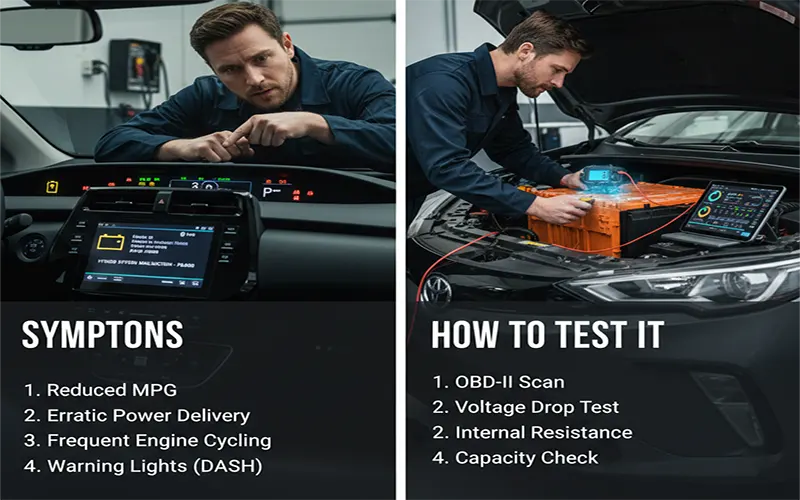
The high-voltage battery in a hybrid vehicle is the heart of its efficiency. Unlike a traditional lead-acid starter battery, which typically fails suddenly and leaves you stranded in your driveway, a hybrid “traction” battery usually dies a slow, lingering death. In the 2026 automotive landscape—where many early-generation hybrids are hitting high mileages and newer lithium-ion models are entering their second decade—recognizing the early warning signs of battery failure is essential for avoiding massive repair bills and maintaining your vehicle’s safety.
This guide outlines the subtle and critical red flags of a failing hybrid battery and provides a roadmap for testing its health using both DIY and professional methods.
Section 1: The Subtle Red Flags
Early symptoms of battery degradation are often overlooked because the car continues to drive. However, these “quiet” warnings are the best time to intervene before a total system shutdown.
- The MPG Slide: If your hybrid, which traditionally averaged 50 MPG, has gradually slipped into the low 40s or high 30s without a change in driving habits or weather, the battery is likely the culprit. As cells lose capacity, the Internal Combustion Engine (ICE) must run more frequently to provide propulsion and keep the battery charged, negating the hybrid benefit.
- The “Swinging” Battery Gauge: Watch your dashboard’s battery energy display. In a healthy car, the level moves slowly. A failing battery often shows “rapid cycling”—it might jump from near-empty to full in just a few minutes of driving, then plummet back down as soon as you accelerate. This indicates that the battery’s actual capacity has shrunk; it “fills up” quickly because it can’t hold much, and “empties” just as fast.
- Engine Dependency & Cold Start Behavior: On a healthy hybrid, the engine shouldn’t necessarily kick in the moment you start the car or crawl through a parking lot. If your ICE fires up immediately every time you start the car, or if it refuses to enter “EV Mode” even when the gauge shows plenty of charge, the battery is likely struggling to maintain the required voltage for electric propulsion.
Section 2: The Critical Alarms
Once the battery reaches a certain level of deterioration, the car’s computer will begin to panic. These symptoms usually require immediate attention.
- The Loud Backseat Fan: Hybrid batteries are sensitive to heat. If you suddenly hear a loud, vacuum-like fan noise coming from the vents near the rear seats, your battery is likely overheating. Deteriorating cells generate more internal resistance, which creates heat. When the fan runs on high constantly, the battery is fighting to stay within a safe operating temperature.
- Dashboard Diagnostic Codes (DTCs): In 2026, most hybrids will throw specific “Standard” and “Enhanced” codes when the battery fails. Common ones include:
- P0A80: “Replace Hybrid Battery Pack.” This is the definitive “it’s over” code. It means the computer has detected a voltage difference between battery modules that exceeds the allowable limit (usually around 1.2V).
- P0A7F: “Hybrid Battery Pack Deterioration.” This often appears before P0A80 and indicates high internal resistance or a general loss of capacity.
- P3011 through P3024: These indicate a specific “block” or module failure.
Section 3: DIY Testing Methods
You don’t always need a dealership to tell you your battery is dying. Modern software and some old-school logic can give you a clear picture.
The “Force Charge” & Discharge Test
This is a manual way to stress-test the battery’s capacity.
- Preparation: Ensure the car is warmed up and parked safely.
- Discharge: With the car “Ready,” put it in Reverse. Hold the brake firmly and lightly press the accelerator (the engine should stay off if the battery is charged). This uses the electric motor to pull power from the battery. Watch how long it takes to drop from full to two bars. A healthy battery should last several minutes; a failing one might drop in under 60 seconds.
- Force Charge: Put the car in Park. Press the accelerator to force the engine to run and charge the battery. A healthy battery will charge steadily; a bad one will “snap” back to a full reading almost instantly.
App-Based Diagnostics (The 2026 Gold Standard)
By using a high-quality Bluetooth OBDII adapter (like OBDLink MX+) and an app like Dr. Prius or Car Scanner, you can view “Real-Time Block Voltages.”
- What to look for: Under a load (accelerating), all blocks should stay within 0.2V of each other. If one block drops significantly lower than the others (e.g., 14.2V while others are 15.1V), that block is failing. These apps often include a “Life Expectancy Test” that uses proprietary algorithms to give you a percentage of remaining health.
Section 4: Professional Benchmarking
If DIY tests are inconclusive, a professional “State of Health” (SOH) report is necessary. Technicians use tools like the Midtronics HYB1000 to measure the internal resistance of every single module.
Critical Note: Before replacing a hybrid battery, always test the 12V auxiliary battery first. A weak 12V battery can cause “ghost” hybrid errors, strange dashboard lights, and erratic hybrid system behavior, leading many owners to waste thousands on a traction battery they didn’t actually need.
The Road Ahead
A failing hybrid battery doesn’t mean the end of the vehicle. In 2026, options range from cleaning your battery cooling filters (a vital preventative step that can extend life by years) to reconditioning individual modules or installing a full aftermarket replacement.
If you notice your MPG dropping and that rear fan getting louder, don’t wait for the “Triangle of Doom” to appear. Early diagnosis allows you to plan your finances and potentially fix the issue with a simple cooling system cleaning rather than a full pack replacement.