

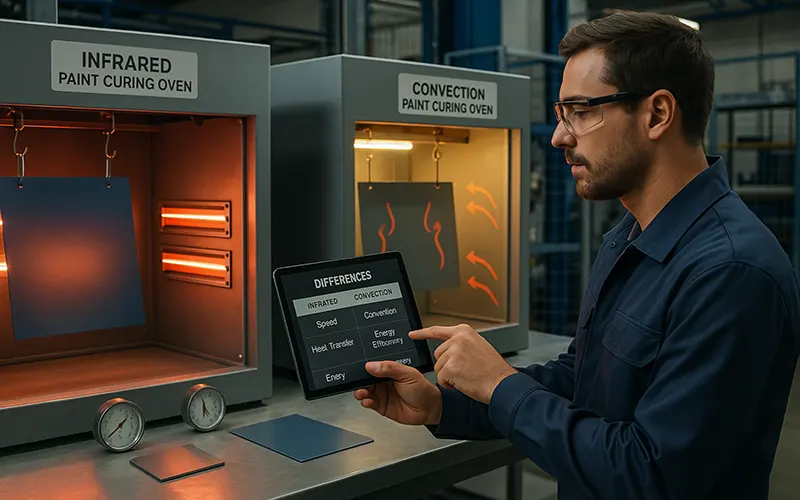
A coating’s final quality depends not just on the paint curing oven itself, but on how its heating method interacts with the surface and the part beneath it. Projects that look identical on paper can deliver very different finishes once heat transfer comes into play. Understanding how infrared and convection systems behave helps teams choose the process that actually supports the finish they need.
Infrared Heats Surfaces Instantly While Convection Warms the Full Part Mass
Infrared energy hits the coated surface immediately, causing the outer layer of the film to respond almost as soon as the oven cycles on. This direct transfer makes infrared heaters effective for parts that require quick surface curing without waiting for the entire piece to heat through. Paint responds noticeably faster under infrared because the coating absorbs radiant energy more efficiently than the metal beneath it.
Deeper warming takes longer in convection systems because heated air has to move around the part and raise its temperature gradually. This slower increase is sometimes preferred since it brings the entire mass of the part to a more stable curing temperature, which reduces the risk of uneven film development. Industrial curing ovens designed for convection processes maintain this balance well for standard production environments.
Convection Offers Deeper Penetration for Thicker Coatings and Heavier Parts
Thicker coatings need time for heat to move inward so the inner film layers can cure properly. Convection heating reaches these depths because warm air circulates around the part until the full mass reaches the target temperature. Heavier components benefit from this gradual penetration since it helps the finish harden evenly. Certain coatings also rely on internal solvent release that requires slower, deeper warming. A convection-style industrial curing oven provides the steady environment that encourages a controlled cure throughout the entire coating thickness.
Infrared Reduces Cycle Times When Fast Surface Curing Is the Priority
Short production runs often require quick turnaround. Infrared excels here because it heats only the areas that need curing instead of raising the temperature of the whole chamber. That direct response allows teams to move parts through the paint curing oven faster without sacrificing adhesion or early-stage gloss.
Another advantage of shortened cycles is reduced energy use, especially for smaller batches. Companies working with limited floor space or time-sensitive projects frequently incorporate infrared systems to keep workflows moving efficiently.
Convection Maintains Uniform Temperatures Across Complex Shapes
Complex geometries—tubing, brackets, frames, or castings—need heat applied on all sides to prevent uneven results. Convection spreads warm air through the chamber so each surface receives similar exposure. This balance is why large or multi-angled parts regularly cure more consistently inside convection industrial curing ovens.
Undersides and tight corners especially benefit from the air circulation. With proper airflow, even shaded regions reach the same temperature range as exposed faces, preventing mismatched sheen or soft spots.
Infrared Responds Quickly to Setpoint Changes During Short Production Runs
Infrared systems can shift temperature ranges almost immediately because the heating elements react directly to electrical changes. This allows operators to adapt the oven to different coating types or part materials without long waits between cycles. Quick adjustments support shops that switch project types frequently.
The rapid response also helps prevent over-curing small batches that don’t require extended heat exposure. A paint curing oven equipped with infrared can maintain tighter control over surface temperature swings during these transitions.
Convection Supports Larger Batch Loads Without Uneven Finish Results
High-volume operations rely on consistent heating across dozens of parts at once. Convection industrial curing ovens handle these conditions because circulating air naturally balances the temperatures between items. This prevents outer racks from curing differently than inner racks. Heat tends to stay more stable across the chamber even when loads vary in size or arrangement. The broader capacity is useful for manufacturers that scale production up or down throughout a shift.
Infrared Excels in Targeted Heating Zones for Selective Curing Needs
Selective curing becomes essential when only specific areas need to reach a certain temperature. Infrared emitters can be arranged to heat zones independently, which limits energy use and prevents unnecessary exposure to other surfaces. This is particularly helpful for mixed-material assemblies. Zone heating also benefits projects that require controlled gloss levels in specific regions. Because radiant energy hits exactly where the operator directs it, finish uniformity becomes easier to maintain for specialized components.
Convection Relies on Airflow Patterns to Ensure Steady Heat Distribution
Airflow inside a convection paint curing oven shapes how evenly temperatures spread through the chamber. Predictable circulation carries heat into corners, around tall parts, and across densely loaded racks. With the right pattern, the coating sees the same curing conditions no matter where the part sits.
Balanced airflow also prevents hot spots that could harden the film too quickly or dull its sheen. Reliant Finishing ovens deliver dependable performance in both convection and infrared systems, ensuring consistent results for every finishing project.