
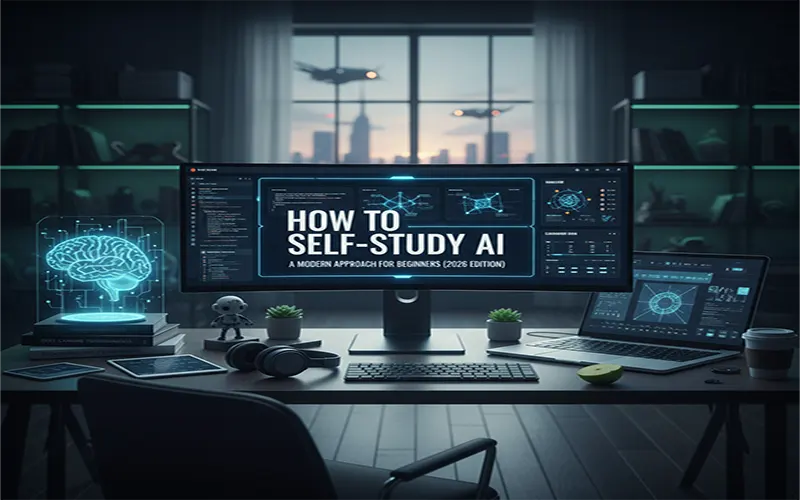
In 2026, the landscape of Artificial Intelligence has shifted from a niche academic pursuit into a foundational literacy. We are no longer just in the era of “coding” software; we are in the era of agentic AI, where models don’t just predict the next word—they reason, plan, and execute tasks. For a beginner, the sheer volume of information can be paralyzing. However, there has never been a better time to self-study. With AI-powered tutors (like the one you are using now) to explain complex math and open-source frameworks that handle the “heavy lifting,” the barrier to entry has crumbled.
This roadmap will take you from zero to building your first autonomous AI agent using a structured, modern approach.
Phase 1: The Foundations (Building the Bedrock)
Before you can build the next great AI, you must speak its language. In 2026, Python remains the undisputed king of AI. Its syntax is readable, and its ecosystem is vast.
- The Language: Focus on Python basics: loops, functions, and Object-Oriented Programming (OOP). You don’t need to be a software engineer, but you must be comfortable manipulating data.
- The Libraries: Master the “Big Three”: NumPy for numerical operations, Pandas for data manipulation, and Matplotlib for visualization.
- The “Just Enough” Math: Do not get bogged down in a four-year math degree. You need:
- Linear Algebra: Understanding how data is stored in matrices and vectors.
- Calculus: Grasping the concept of gradients (how models minimize error).
- Probability: Learning Bayesian thinking, which is how AI manages uncertainty.
Modern Tip: Use an AI tutor to explain these concepts. Ask: “Explain matrix multiplication using a grocery store analogy,” or “Show me the intuition behind a derivative without using complex formulas.”
Phase 2: The Classical Machine Learning Bridge
You cannot understand how a Large Language Model (LLM) works without understanding the classical algorithms that preceded it. This phase is about learning to find patterns in data.
- Supervised Learning: This is learning by example. Study Linear Regression (predicting numbers) and Decision Trees/Random Forests (classification).
- Unsupervised Learning: This is finding hidden structures. Learn K-Means Clustering (grouping similar items) and Principal Component Analysis (PCA) for simplifying complex data.
- Tools: Use Scikit-learn. It is the gold standard for implementing these algorithms with just a few lines of code.
Phase 3: The Deep Learning & Transformer Era
This is where the “magic” happens. Deep Learning uses “Neural Networks”—layers of artificial neurons inspired by the human brain—to process information.
- Neural Network Basics: Learn about backpropagation (how the network learns from its mistakes) and activation functions.
- The Transformer: This is the specific architecture behind ChatGPT and Gemini. Study the Attention Mechanism, which allows models to weigh the importance of different pieces of information in a sequence.
- The Frameworks: Choose PyTorch. While TensorFlow is powerful, PyTorch is the industry favorite for research and modern AI development in 2026 due to its flexibility and “Pythonic” feel.
Phase 4: The 2026 Edge—Agents and LLM Engineering
We have moved beyond just “chatting” with AI. The current frontier is Agentic AI—systems that use LLMs as a “brain” to control tools, browse the web, or write code to solve problems.
- RAG (Retrieval-Augmented Generation): Instead of just relying on a model’s internal memory, learn how to connect an AI to a private database of documents so it can provide accurate, grounded answers.
- AI Agents: Study frameworks like LangGraph, CrewAI, or AutoGen. These allow you to define a “goal” and let the AI plan the steps to achieve it.
- API Mastery: Learn to work with models via APIs (OpenAI, Anthropic, or Google) and how to run smaller, open-source models (like Llama) locally using tools like Ollama.
Phase 5: Building Your Portfolio (The Capstone)
Knowledge without application is quickly forgotten. In 2026, a “portfolio” of tutorial-following projects is not enough. You need to solve a real-world problem.
The Capstone Suggestion: Build a Personalized AI Research Agent.
- Use Python to scrape news on a topic you love (e.g., space exploration).
- Use RAG to store that info in a vector database.
- Build a LangGraph agent that reads the news every morning and sends you a summarized report of the most important updates.
Your Curated Starter Kit
To help you get started today, here is a list of the highest-rated resources for 2026:
| Resource Type | Recommended Tool/Book | Why it matters |
| The “Bible” | Artificial Intelligence: A Modern Approach (Russell & Norvig) | The definitive academic foundation. |
| Hands-on Book | Hands-On Machine Learning (Aurélien Géron) | The best practical guide for Scikit-Learn and PyTorch. |
| Online Platform | DeepLearning.AI (Andrew Ng) | The “gold standard” for beginner-to-intermediate courses. |
| Community | Kaggle | Compete in data science challenges and learn from others’ code. |
| Computing | Google Colab | Access powerful GPUs for free in your browser to train models. |
The Secret to Success: AI moves fast, but the fundamentals (Math, Python, Logic) are timeless. Don’t chase every new “hype” model; instead, focus on understanding why the models work the way they do.