
For hybrid vehicle owners in 2026, the high-voltage battery is no longer a “black box” mystery—it is a high-value asset that requires active management. While modern engineering has made these packs more resilient, the laws of electrochemistry remain unchanged: extreme temperatures are the single greatest threat to battery longevity. Whether you are navigating a $45^\circ\text{C}$ heatwave in Arizona or a $-25^\circ\text{C}$ winter in Calgary, your battery is fighting a constant battle against chemical degradation.
This guide provides a technical roadmap to maintaining the “Goldilocks Zone”—the $15\text{–}30^\circ\text{C}$ sweet spot where your battery operates with maximum efficiency and minimum wear.
Section 1: The Silent Killer—Extreme Heat
Heat is the primary cause of permanent, irreversible capacity loss. In 2026, as urban heat islands intensify, hybrid owners must understand two critical processes: electrolyte evaporation and thermal runaway.
In high-heat environments, the chemical reactions inside your battery (whether Nickel-Metal Hydride or Lithium-ion) accelerate. While this initially seems to boost performance, it leads to “side reactions” that consume the battery’s active materials. In NiMH packs, excessive heat can cause the internal electrolyte to “outgas,” leading to high internal resistance.
The “Shade or Bust” Rule
In 2026, parking in direct sunlight during peak hours is a maintenance sin. A car’s interior can reach $60^\circ\text{C}$ in minutes, and since many hybrid batteries are located under the rear seat or in the trunk, they soak up that ambient heat. Always prioritize covered parking. If shade is unavailable, use high-quality ceramic window tints and reflective sunshades. Keeping the cabin cool indirectly keeps the battery cool.
The Filter Factor: Your #1 Defense
Most air-cooled hybrids (like the Toyota Prius and RAV4) feature a dedicated battery cooling intake vent and filter, usually located near the rear passenger seat or floor. In dusty or high-heat climates, these filters clog with debris, lint, and pet hair. A clogged filter is a death sentence for a battery; it starves the pack of cool cabin air, forcing the battery to operate at high temperatures even with the AC on. Check this filter every 10,000 miles. If your battery fan sounds like a jet engine, your filter is likely blocked.
Section 2: The Efficiency Thief—Extreme Cold
Cold weather rarely “kills” a battery permanently, but it significantly hinders performance and can lead to structural damage if handled incorrectly.
“Molasses” Electrolytes & Internal Resistance
In freezing temperatures, the electrolyte fluid inside the cells becomes more viscous (thicker). This makes it harder for lithium ions to move between the anode and cathode. From the driver’s perspective, this manifests as a “sluggish” car and a gas engine that refuses to shut off. Because the battery cannot accept or provide power easily, the car relies almost entirely on the internal combustion engine.
The Danger of “Lithium Plating”
The most significant risk in sub-zero weather is Lithium Plating. If you attempt to use heavy regenerative braking or fast-charging when the battery is “frozen” (below $0^\circ\text{C}$), the ions cannot enter the anode quickly enough. Instead, they “plate” onto the surface as metallic lithium. Over time, this creates dendrites—tiny metallic spikes—that can eventually puncture the internal separator, causing a short circuit.
Section 3: Operational Strategies for 2026
Modern technology offers tools to mitigate climate stress that weren’t available a decade ago.
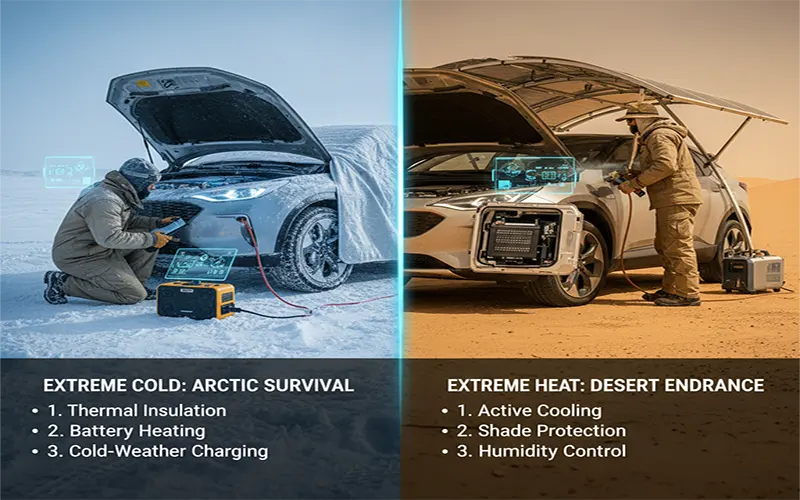
- Pre-conditioning via App: If you own a modern hybrid or PHEV, use the manufacturer’s app to “Pre-condition” the car while it is still plugged into a Level 2 charger. This uses grid power to bring the battery to an optimal temperature before you start your journey, saving the battery from the high-stress task of heating or cooling itself while driving.
- The 20-80% Rule: In extreme heat, avoid leaving your car sitting for days at 100% State of Charge (SoC). High voltage combined with high heat creates a “pressure cooker” effect for the cell chemistry. Aim to park it with a 50–60% charge if it will be sitting in a hot garage.
- The “Gentle Start” Philosophy: In extreme cold, drive gently for the first 10 minutes. This allows the internal resistance of the battery to generate a small, safe amount of heat naturally before you ask it for high-power acceleration or heavy regen.
Section 4: Technical Maintenance Checklist
To ensure your hybrid battery reaches its 15th birthday and beyond, implement this season-change inspection:
- Check Liquid Coolant: If your 2026 hybrid uses a liquid-cooled battery (common in many newer PHEVs), ensure the dedicated inverter/battery coolant is at the correct level and has not become acidic.
- Test the 12V Auxiliary Battery: Ironically, many “Hybrid System Failure” lights in winter are caused by a failing 12V starter battery. Extreme cold kills 12V batteries easily; if the 12V is weak, it cannot “boot up” the high-voltage computer.
- Clean the Fan Blades: Once every two years, have a technician (or a savvy DIYer) check the actual cooling fan blades for dust buildup. A clean filter is good, but a clean fan is better.
Extending hybrid battery life in 2026 is about proactive thermal management. By keeping your cooling filters clean, utilizing pre-conditioning apps, and respecting the chemical limits of heat and cold, you can push your battery’s lifespan far beyond the manufacturer’s warranty. A well-maintained battery doesn’t just save you $5,000 in replacement costs; it keeps your vehicle’s carbon footprint as small as possible for years to come.
| Climate Challenge | Primary Risk | Best Practice |
| Extreme Heat | Chemical Aging / Evaporation | Clean intake filters; park in shade. |
| Extreme Cold | Lithium Plating / High Resistance | Pre-condition while plugged in; drive gently at start. |
| Dusty/Arid | Clogged Cooling Systems | Inspect battery filter every 10k miles. |
| High Humidity | Terminal Corrosion | Ensure battery seals are intact during service. |