
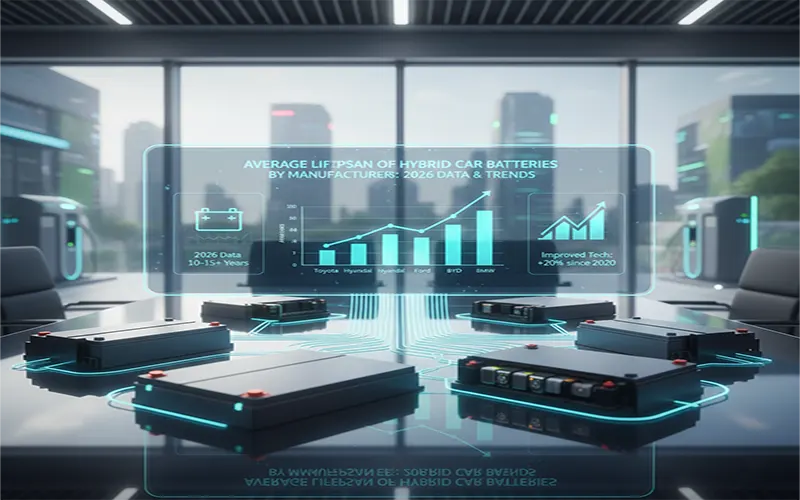
The hybrid vehicle market in 2026 is a landscape transformed, marked by rapid technological advancements, evolving consumer expectations, and a clearer understanding of long-term component durability. A central pillar of this evolution is the hybrid battery—once a source of anxiety for potential buyers, now a testament to engineering longevity. This article dives deep into the average lifespan of hybrid car batteries, breaking down performance by manufacturer and shedding light on the critical factors influencing their durability as we navigate the mid-2020s.
The 2026 Market Context: Shifting Perceptions and Costs
By 2026, the specter of prohibitively expensive battery replacements has largely dissipated. Industry data indicates that the average cost per kilowatt-hour (kWh) for replacement hybrid battery packs has stabilized, reaching near-parity with complex traditional engine repairs—typically ranging from $80 to $111 per kWh. This significant reduction, driven by economies of scale, improved manufacturing processes, and increased competition, means that replacing a 1.3 kWh Toyota Prius battery, which once soared past $4,000, now averages between $1,800 and $2,500, including labor.
This shift has solidified the “10-year/150,000-mile” warranty as a prevalent industry standard. Many manufacturers, particularly those in regions adhering to California’s stringent emissions standards (CARB states), offer warranties extending even further, underscoring their confidence in battery resilience. Consumers in 2026 can approach hybrid ownership with greater assurance, knowing that the primary power source is designed for the long haul.
Differentiating Hybrid Battery Lifespans: MHEV, HEV, and PHEV
Not all hybrid batteries are created equal, nor are their operational demands. Understanding the three primary types of hybrids is crucial to appreciating their respective battery lifespans:
- Mild Hybrids (MHEV): These systems use a small battery and electric motor primarily to assist the internal combustion engine (ICE) during acceleration and to power accessories. Their batteries experience shallow discharge and charge cycles, leading to extremely long lifespans, often matching the vehicle’s total operational life (200,000+ miles).
- Full Hybrids (HEV): As popularized by the Toyota Prius, HEVs utilize their battery more extensively, allowing for short bursts of electric-only driving. While the battery is cycled more frequently than an MHEV, advanced battery management systems (BMS) meticulously keep the state of charge (SoC) within an optimal, narrow band (e.g., 40-80% for a Prius). This “shallow cycling” strategy significantly extends longevity, typically well beyond 150,000 miles.
- Plug-in Hybrids (PHEV): PHEVs feature larger battery packs designed for extended electric-only range, requiring deeper discharge cycles (e.g., from 100% down to 20%). While their overall energy throughput is higher, leading to more “equivalent” full cycles, modern PHEV batteries are engineered with greater capacity and robust thermal management to withstand these demands. Their projected lifespans are often comparable to HEVs, though individual usage patterns (frequent deep discharges vs. shallow daily charging) play a larger role.
Manufacturer-Specific Battery Lifespan & Warranty Insights (2026)
Here’s a breakdown of what consumers can expect from leading hybrid manufacturers in 2026:
| Manufacturer | Avg. Lifespan (Miles) | Warranty (2026 Models) | Battery Chemistry |
| Toyota / Lexus | 180,000 – 250,000+ | 10yr / 150,000 miles | NiMH / Lithium-ion |
| Honda | 150,000 – 200,000 | 8yr / 100,000 miles | Lithium-ion |
| Hyundai / Kia | 160,000 – 200,000 | 10yr / 100,000 miles | Lithium-ion Polymer |
| Ford | 150,000 – 180,000 | 8yr / 100,000 miles | Lithium-ion |
| BMW (PHEV) | 120,000 – 160,000+ | 8yr / 80,000 miles (federal) | Lithium-ion (High Density) |
Toyota / Lexus: Toyota remains the benchmark for hybrid battery longevity. Their long-standing expertise with nickel-metal hydride (NiMH) batteries, especially in models like the Prius, has demonstrated exceptional resilience, with many vehicles exceeding 250,000 miles on their original packs. Even as they increasingly integrate lithium-ion into newer models and PHEVs, their sophisticated thermal management and conservative SoC strategies continue to deliver industry-leading lifespans. Their 10-year/150,000-mile warranty for 2026 models in many states reflects this confidence.
Honda: Honda’s hybrid offerings, while robust, generally exhibit slightly lower average lifespans than Toyota, often in the 150,000-200,000-mile range. Their reliance on lithium-ion batteries across their HEV and PHEV lineup is complemented by solid thermal management. Honda typically offers an 8-year/100,000-mile warranty, with extensions in CARB states.
Hyundai / Kia: These Korean automakers have made significant strides in hybrid technology. Their commitment to lithium-ion polymer batteries, which offer flexibility in packaging and good thermal properties, has yielded strong results. Owners can expect 160,000-200,000 miles, backed by an impressive 10-year/100,000-mile powertrain warranty that often includes the hybrid battery.
Ford: Ford’s hybrid vehicles, like the Escape and Fusion hybrids, have demonstrated respectable battery longevity. Their lithium-ion packs typically perform for 150,000-180,000 miles under normal conditions. Ford’s standard hybrid component warranty mirrors the federal mandate of 8-year/100,000 miles.
BMW (PHEV): As a luxury brand, BMW’s focus has largely been on plug-in hybrids, integrating powerful electric motors with their premium powertrains. While their high-density lithium-ion batteries are designed for performance, their deeper discharge cycles might lead to a slightly lower average lifespan compared to the shallow-cycled HEVs, though still well within acceptable bounds (120,000-160,000+ miles). Their federal warranty is 8-year/80,000 miles, with CARB states seeing extensions.
Factors of Degradation: Calendar vs. Cycle Aging
By 2026, the scientific understanding of battery degradation is highly refined:
- Calendar Aging: This refers to the natural chemical degradation of a battery over time, regardless of usage. High temperatures and prolonged exposure to very high or very low states of charge accelerate this process. Modern liquid-cooled battery packs found in nearly all 2026 hybrids and PHEVs are vastly superior to the passively or air-cooled designs of early models, significantly mitigating temperature-related calendar aging.
- Cycle Aging: This is the wear and tear caused by charging and discharging the battery. Deeper discharge cycles (as in PHEVs) stress the battery more than shallow cycles (as in HEVs). However, sophisticated Battery Management Systems (BMS) in 2026 vehicles are adept at managing these cycles, optimizing performance and longevity. The introduction of LFP (Lithium Iron Phosphate) battery chemistry into some 2026 hybrid models is a notable trend, offering lower energy density but significantly higher cycle life (often 3,000+ cycles), further enhancing durability.
Signs of a Failing Hybrid Battery in 2026
While modern batteries are robust, recognizing potential issues can help:
- Decreased Fuel Economy: A noticeable drop (10-15%) in MPG is often the first indicator.
- Engine Cycling: The internal combustion engine kicking in more frequently or almost immediately after a stop, even at low speeds.
- Erratic SoC Display: The battery charge indicator on the dashboard rapidly fluctuating from high to low, or not holding a charge as long.
- Warning Lights: A “Check Hybrid System” or similar warning light on the dashboard.
Maximizing Longevity in 2026
Hybrid battery lifespan isn’t solely in the hands of the manufacturer. Owners can take proactive steps:
- Regular Maintenance: Adhere to the manufacturer’s service schedule, especially for powertrain checks that may include battery diagnostics.
- Software Updates: Keep your vehicle’s software updated. Manufacturers continually refine battery management algorithms to optimize charging, discharging, and thermal control.
- Mindful Charging (PHEVs): For PHEV owners, avoid consistently charging to 100% if you don’t need the full range daily, and try not to let the battery sit at very low states of charge for extended periods. Most PHEVs automatically reserve a buffer at the top and bottom of the charge, but moderation helps.
- Consider Third-Party Remanufactured Batteries: As the hybrid market matures, a robust ecosystem of high-quality remanufactured batteries has emerged by 2026. These options can provide a cost-effective and environmentally friendly alternative to new OEM packs, often coming with competitive warranties.
In 2026, the hybrid car battery has evolved from a nascent technology to a highly reliable and long-lasting component. With average lifespans consistently pushing beyond 150,000 miles, robust warranties, and falling replacement costs, the concerns of early adopters have largely faded. Whether it’s the legendary endurance of a Toyota, the refined engineering of a Hyundai, or the performance-oriented packs of a BMW PHEV, today’s hybrid batteries are built to last, providing years of efficient and dependable service. Owners can drive with confidence, knowing their hybrid investment is a sound one for the long road ahead.