
For the last decade, the electric vehicle (EV) industry has been running a marathon in lead boots. While we have seen incredible advances in software, motor efficiency, and aerodynamics, the core technology powering our vehicles—the lithium-ion battery—has remained fundamentally unchanged since Sony commercialized it in 1991.
Current EV owners live with a set of unspoken compromises. We accept that “fast charging” still takes 20 to 40 minutes. We accept that cold weather slashes our range by 30%. We accept that degradation is inevitable. But a technological shift is on the horizon that promises to erase these compromises entirely.
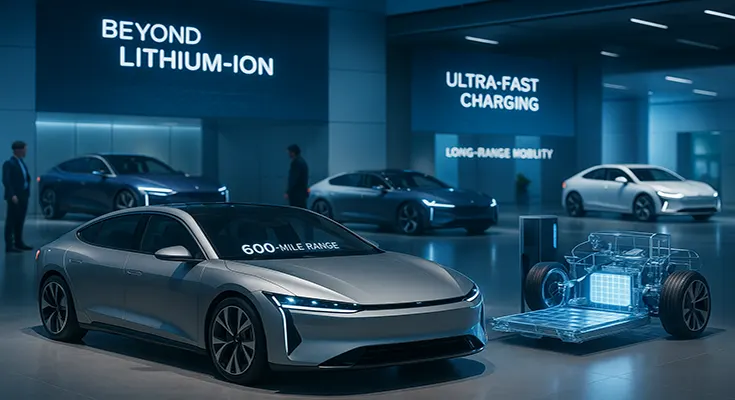
We are standing on the precipice of the Solid-State Battery (SSB) revolution. This isn’t just an incremental update; it is a generational leap in physics and chemistry that aims to deliver the “Holy Grail” of electric mobility: the 600-mile range EV that charges in 10 minutes.
If you are the type of buyer who refuses to settle for “good enough,” and you are waiting for the technology that finally kills the internal combustion engine for good, this is the future you are waiting for.
The Bottleneck: Why Liquid Lithium-Ion Has Peaked
To understand why solid-state is such a big deal, we have to look at the limitations of what is currently under the floorboards of a Tesla or a Hyundai.
Shutterstock
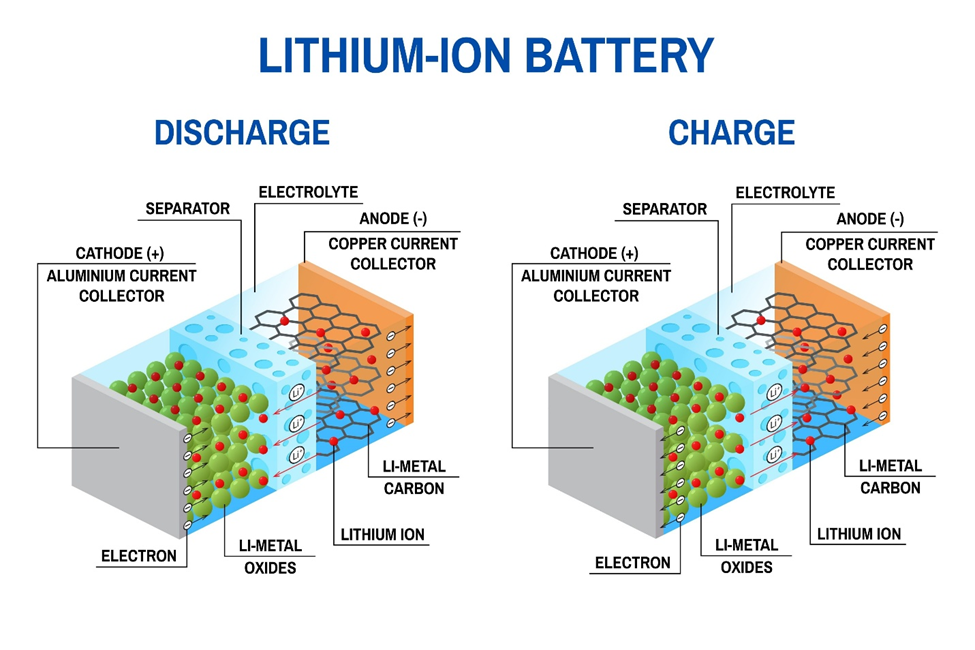
Conventional lithium-ion batteries consist of a cathode and an anode separated by a liquid electrolyte solution. This liquid is the medium through which ions move to create electricity. While effective, it has severe drawbacks:
- Safety: The liquid is flammable. This requires heavy, expensive cooling systems and safety cages to prevent thermal runaway.
- Energy Density: There is a physical limit to how much energy you can store in this liquid format without making the battery dangerously unstable.
- Voltage Limits: High-voltage charging generates heat that degrades the liquid electrolyte, limiting how fast we can charge.
We have essentially squeezed the lemon dry on liquid lithium-ion tech. To get more range now, manufacturers just have to make the batteries bigger and heavier, which hurts efficiency. We need a new paradigm.
The Solid-State Solution: How It Works
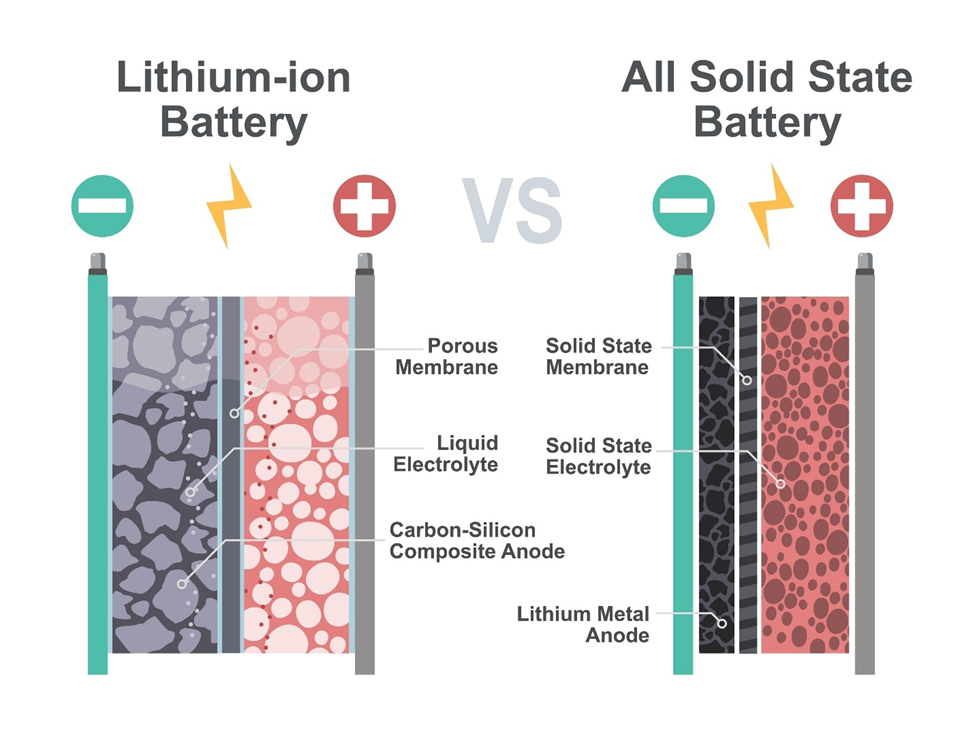
Solid-state batteries replace that volatile liquid electrolyte with a solid material—typically a ceramic, glass, or sulfide-based compound.
Shutterstock
This simple swap changes the physics of the battery entirely:
- Higher Energy Density: Because the solid separator is thinner and safer, you can use more energy-dense materials for the anode (like pure lithium metal instead of graphite). This can theoretically double the energy density (Wh/kg).
- 600-Mile Range: With double the density, you can fit 600 miles of range into the same physical space that currently holds 300 miles. Or, you could have a 300-mile car that weighs significantly less.
- The 10-Minute Charge: Solid electrolytes are more resistant to heat. This means they can handle massive surges of power—potentially charging from 10% to 80% in under 10 minutes—without the degradation risks of current tech.
The Roadmap: Who is Building Them and When?
This technology has moved beyond the university lab and into the R&D centers of the world’s largest automakers. However, mass manufacturing these batteries is incredibly difficult. Here is the realistic roadmap for when you can buy one.
1. Toyota: The Giant Awakens (2027-2028)
Toyota was slow to embrace the current EV wave, leading to criticism from environmental groups. However, their strategy was to bet the farm on the next wave. Toyota holds more patents for solid-state battery technology than any other company in the world.
They have announced plans to launch a commercial solid-state EV by 2027 or 2028. Their stated targets are staggering:
- Range: 1,000 km (approx. 621 miles) initially, with future optimizations pushing to 745 miles.
- Charging: 10 to 80 percent charge in 10 minutes.
Toyota plans to introduce this tech in a premium vehicle first (likely a Lexus), as the initial cost of the batteries will be high.
2. Nissan: The “Game Changer” (2028)
Nissan, the pioneer behind the original Leaf, is looking to reclaim its throne. They are currently constructing a pilot plant in Yokohama specifically for solid-state production. Nissan has committed to launching an EV with this tech by fiscal year 2028.
Their engineers claim that solid-state tech will reduce the cost of battery packs to $75 per kWh (current averages are around $130-$140). If achieved, this would make EVs cheaper to produce than gas cars, finally solving the affordability crisis alongside the range crisis.
3. Volkswagen & QuantumScape (2025-2026 Testing)
The Volkswagen Group has poured hundreds of millions into QuantumScape, a Silicon Valley startup that is arguably the furthest ahead in solving the “dendrite problem” (a technical hurdle where lithium spikes puncture the battery).
QuantumScape has already shipped prototype cells to VW for testing. While they haven’t set a hard date for a car on a showroom floor, the results have been promising. Their cells retained more than 95% of their capacity after 1,000 charging cycles—equivalent to driving a car 300,000 miles with almost no battery degradation.
4. Nio: The “Semi-Solid” Bridge (Available Now)
If you can’t wait until 2028, the Chinese manufacturer Nio offers a glimpse of the future today. They have already successfully tested a 150-kWh semi-solid-state battery.
In a real-world test in late 2023, a Nio ET7 drove over 650 miles on a single charge without stopping. Note the distinction: this is “semi-solid” (a hybrid of solid and liquid components). It offers the range benefits but is currently incredibly expensive to produce—Nio executives once joked that the battery pack alone costs as much as a Mercedes E-Class.
The Reality Check: The Early Adopter Tax
If you are eyeing a 600-mile solid-state EV, you need to prepare your wallet.
When these cars arrive (likely 2026-2028), they will not be the affordable hatchbacks discussed in other articles. They will be flagship models—luxury sedans and high-performance sports cars.
- Limited Availability: Production yields for solid-state cells are currently low. The first few years will be supply-constrained.
- Premium Pricing: Expect the first generation of these vehicles to cost upwards of $80,000 to $100,000.
Just like flat-screen TVs or the original Tesla Roadster, the technology will start at the top and trickle down to the economy class over the subsequent 5-10 years.
Conclusion: Is It Worth the Wait?
The promise of the 600-mile EV with a solid-state battery essentially solves every functional objection to electric ownership. It removes the fear of running out of power in remote areas. It makes road-tripping as fast as gas-tripping. It ensures the car you buy today will still have a healthy battery fifteen years from now.
If you are currently driving a lease or a gas car that has a few good years left in it, holding out for the 2027-2028 cycle might be the smartest move you can make. We are currently in the “iPhone 3G” era of electric cars—functional and exciting, but bulky and limited. Solid-state is the “iPhone 4” moment—the refinement that sets the standard for the next decade.
The electric revolution has started, but the solid-state revolution will be the one that finishes the job.